Best Social Media Management Software for Agencies (2026)
Postqued is the strongest value in this shortlist for an agency that wants client workspaces, approvals, unlimited team seats, and AI-agent or API automation in one managed product. Pro costs $49 per month for 30 connected accounts with unlimited workspaces and seats; Agency costs $199 for unlimited accounts, workspaces, seats, and posts. PostPlanify is a better fit when a higher-tier white-label dashboard is mandatory, Planable goes deeper on visual review and approval stages, Mixpost fits self-hosted agencies, and Zernio fits a developer-first service model.
Agency software should be evaluated at the number of clients, accounts, users, and approval workflows the team will actually operate. A low entry price can become expensive when every client requires another workspace, reporting add-on, or bundle of social profiles.
Disclosure and methodology: Postqued publishes this comparison and is included in it. We desk-researched public pricing pages and official product documentation; we did not conduct retained hands-on tests of every product. Prices and features were reviewed on August 9, 2026. See the comparison methodology, and verify current terms with each vendor before purchasing.
The best agency social media management tools at a glance
| Product | Best agency fit | Published entry point | Main tradeoff to check |
|---|---|---|---|
| Postqued | Shared client workspaces for teams and AI agents | Pro: $49/month for 30 accounts; Agency: $199 for unlimited accounts | No white-label dashboard, social listening, DMs, or all-network analytics |
| PostPlanify | Agency suite with AI tools and higher-tier white labeling | $99/month for 15 accounts, 5 workspaces, and 3 users | Approvals begin on Premium; white label begins on Scale |
| Planable | Detailed feedback, annotations, and approval workflows | $39/workspace/month on Basic | Pricing is per workspace; analytics and inbox are add-ons |
| Mixpost | Self-hosted agencies with technical operations | Free Lite; $299 one-time Pro license | The agency owns deployment, security, backups, and updates |
| Postiz | Open-source control and broad channel coverage | $29/month for 5 cloud channels; self-hosting available | Client-service workflow is less specialized than dedicated agency products |
| Zernio | Developer-led agencies and embedded automation | First 2 accounts free, then graduated per-account pricing | Per-account cost and separate X usage require volume modeling |
These products solve different versions of agency work. A finished client workspace, a collaborative review system, a white-label portal, a self-hosted deployment, and an API platform should not be treated as interchangeable.
What should agency social media software manage?
Agency social media management software should separate clients, control who can review or publish, preserve feedback and approval history, and make the total cost predictable as accounts grow. Scheduling is only one part of the workflow.
Before choosing a product, document whether the agency requires:
- A separate workspace for each client or brand
- Internal review before the client sees a draft
- Client comments, change requests, and explicit approval
- Roles that prevent the wrong person from publishing
- Revision history and a record of the approved version
- Bulk or multi-account publishing
- Analytics and reports for the networks in scope
- Comment-and-reply management, DMs, or social listening
- A public API and MCP server, or automation platform
- White-label dashboards, reports, email, or custom domains
No product in this list leads on every item. Treat missing functionality as a workflow decision, not a footnote.
How we evaluated agency fit
We focused on products that smaller and growing agencies can realistically consider. We compared:
- Client separation: workspaces, brands, projects, and account organization.
- Review controls: comments, revisions, approval stages, roles, and client access.
- Capacity: accounts, posts, workspaces, and team seats at published monthly prices.
- Service delivery: analytics, engagement, reporting, and white-label options.
- Automation: API and MCP, webhooks, quotas, and agent compatibility.
- Operations: managed SaaS versus infrastructure the agency must run itself.
We did not assign an arbitrary overall score. The decision table recommends a product for a defined operating model.
1. Postqued — best value for shared client and agent workflows
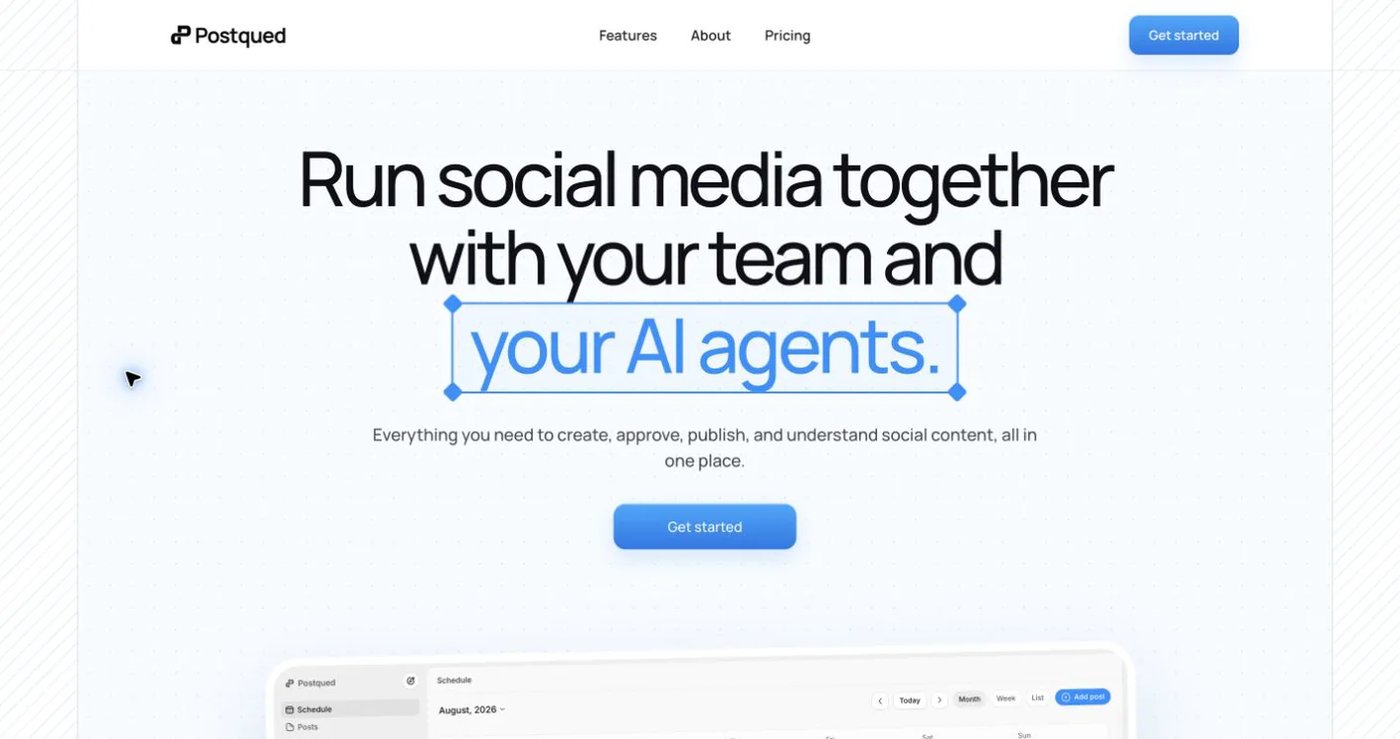
Postqued is designed for agencies that want people and AI agents working inside the same scoped social media workspace. The dashboard covers calendars, drafts, media, feedback, approvals, publishing, post-level analytics, and an Engagement Inbox. The REST API and remote MCP server expose automation through the same organization and workspace boundaries.
Postqued Pro costs $49 per month and includes 30 connected accounts, unlimited workspaces, unlimited team seats, and unlimited posts. Agency costs $199 and removes the connected-account limit. Both include all 10 publishing networks.
Agency workflow capabilities include:
- Separate workspaces for clients or brands
- Roles, collaborators, and invitations
- Internal comments and caption suggestions
- Change requests and revision-aware approval decisions
- Client-review assignments
- Scheduling or publishing after the relevant approval
- API and MCP access without a separate enterprise contract
The boundaries matter. Postqued does not currently provide white-label dashboards or reports, social listening, direct messages, ad management, or competitor tracking. Analytics covers five of the 10 publishing networks, while the Engagement Inbox supports comments and replies on seven networks. Check the product facts and platform documentation against every client deliverable.
2. PostPlanify — best for an agency-oriented suite and white labeling
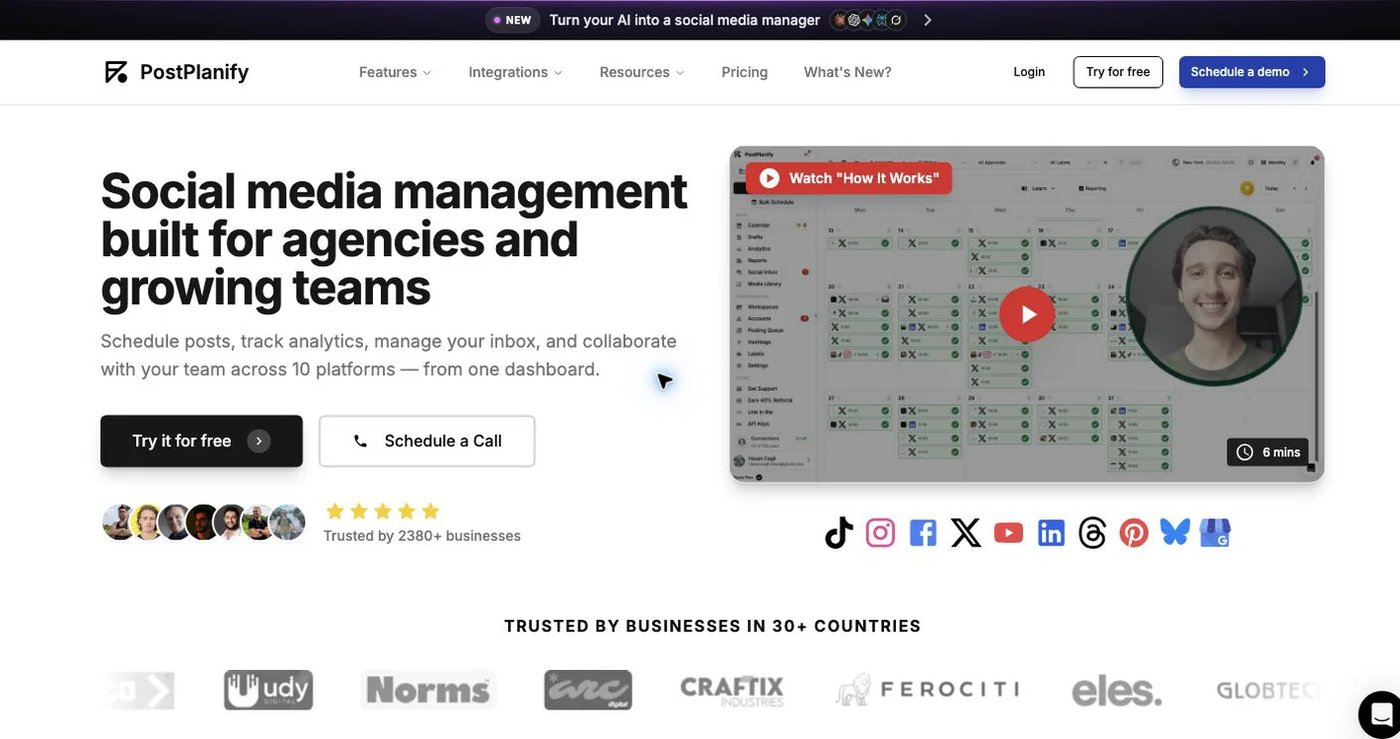
PostPlanify is the clearest agency-specialist option in this shortlist. Growth costs $99 per month for 15 accounts, five workspaces, and three users. Premium costs $199 for 30 accounts and adds approvals; Scale costs $399 for 100 accounts and adds higher-tier white-label capabilities. Enterprise uses custom limits and pricing.
It documents 10-platform publishing, unlimited posts, AI content and image tools, a social inbox, API and MCP access, client roles, comments, mentions, reports, and collaboration features. Its packaging is designed around an agency buying multiple client workspaces from the beginning.
Choose PostPlanify when its AI creation tools, social inbox workflow, client collaboration, and white-label presentation justify the higher plan. Check the exact tier carefully: approval and white-label requirements do not live on the same entry plan. Review PostPlanify pricing, its plan guide, and collaboration features.
3. Planable — best for detailed content review and approvals

Planable is a specialist collaboration product for agencies whose central problem is reviewing content with clients. It emphasizes visual previews, comments, annotations, versioning, optional or required approvals, and review of social and non-social content.
Basic costs $39 per workspace month to month for four social pages, 60 posts, and unlimited users. Pro costs $59 per workspace for 10 pages, 150 posts, required approvals, and public API access. MCP is listed across plans; analytics and Social Inbox are separate workspace add-ons.
Planable can be the better choice when the client experience and multi-stage content review matter more than bundled account volume. Model one workspace for each client: per-workspace pricing can scale differently from Postqued Pro’s fixed $49 plan with unlimited workspaces. Review the current Planable pricing and pricing help.
4. Mixpost — best for agencies that want to self-host
Mixpost fits an agency that deliberately wants the scheduler and connected-account data on its own infrastructure. Its $299 one-time Pro license lists the full platform catalog, unlimited social accounts, unlimited users, workspaces, approvals, API, MCP, and webhooks. A free Lite edition exists but covers a much smaller three-platform workflow.
Self-hosting can support data-control or product-customization requirements, but it is not free operations. The agency becomes responsible for deployment, provider setup, access control, monitoring, backups, security patches, and upgrades. Paid licenses include one year of updates.
Choose Mixpost when infrastructure ownership is a requirement and the agency has the technical capacity to operate it. Otherwise, compare the license plus labor and hosting with a managed subscription. See Mixpost pricing and documentation.
5. Postiz — best for open-source control and channel breadth
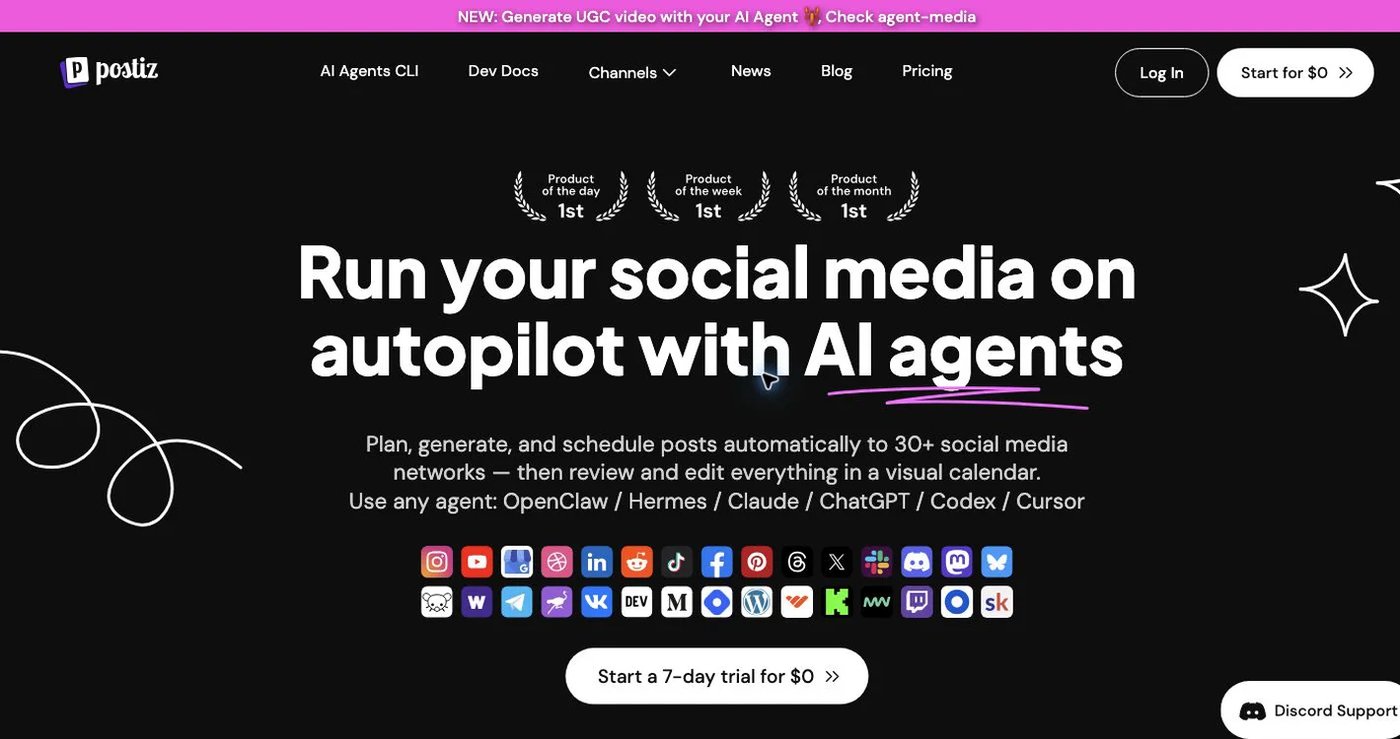
Postiz works well for an agency that values open-source deployment and a broad catalog of social, community, and publishing channels. Its cloud plans list Standard at $29 for five channels, Team at $39 for 10, Pro at $49 for 30, and Ultimate at $99 for 100. Current paid cloud plans list unlimited posts and API access.
It also documents self-hosting, webhooks, RSS automation, repeated posts, and AI content or media tools. That breadth can matter for an agency whose client mix extends beyond the 10 conventional networks supported by Postqued.
Postiz is less explicitly organized around formal client-service packaging than PostPlanify or Planable. Confirm how you will separate clients, grant access, collect approvals, and support the deployment before choosing it for an agency. Review Postiz pricing, documentation, and the public API.
6. Zernio — best for developer-led agency automation
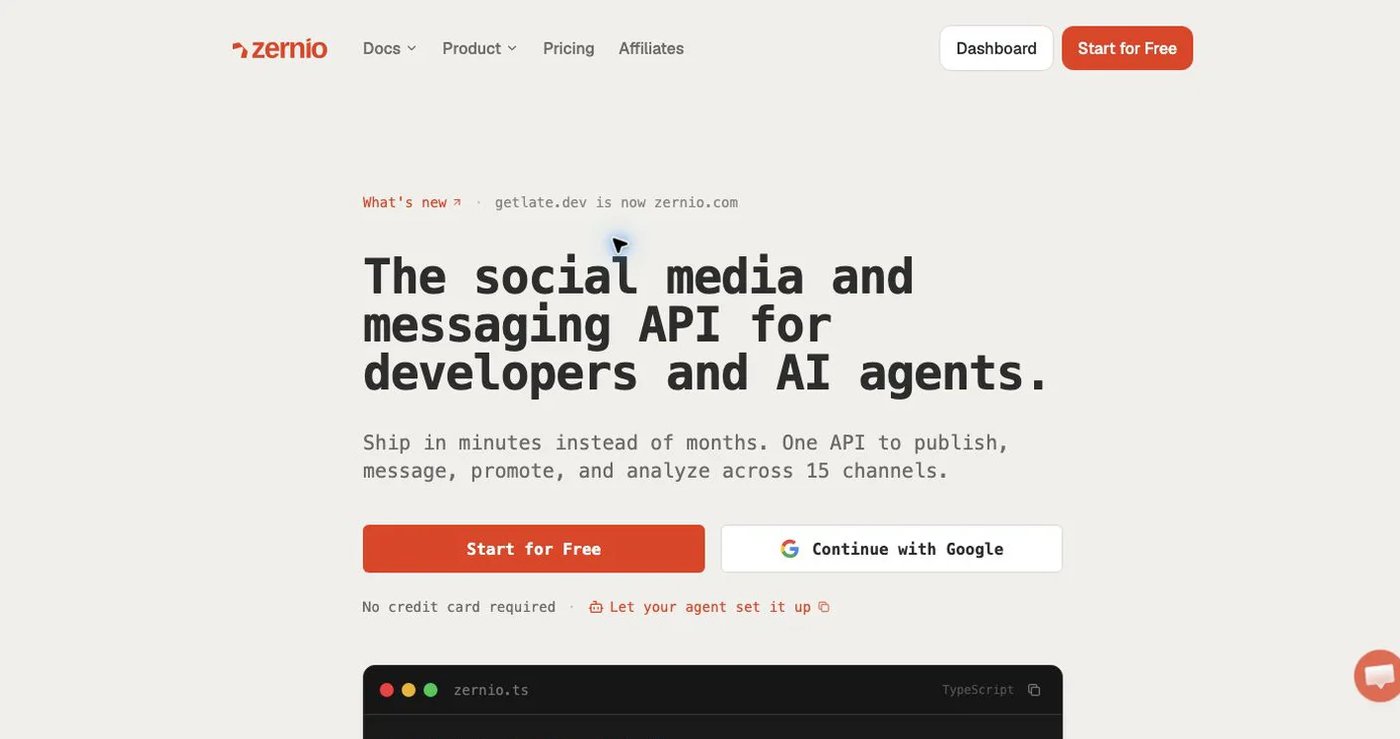
Zernio fits an agency that treats social publishing as an API and automation problem. It documents 15 platforms, unlimited posts, analytics, an inbox, unlimited team members, agent workflows, and separate reviews and ads APIs.
Its pricing is graduated by connected account: the first two accounts are free, accounts 3–10 cost $6 each, accounts 11–100 cost $3 each, and accounts above 100 cost $1 each. X API usage is billed separately. That creates a different cost curve from a fixed agency plan.
Zernio does not use the same client-workspace model as Postqued, so a technical agency should evaluate how it will represent clients, permissions, approvals, and reporting around the API. Choose it when the broader platform set, developer surface, or ads and reviews APIs are more important than a conventional client calendar. See Zernio pricing and platform coverage.
Agency cost scenarios
Headline prices become more useful when attached to an operating scenario.
| Scenario | A sensible starting point | Why |
|---|---|---|
| Up to 30 connected accounts, many workspaces, several staff | Postqued Pro at $49/month | Unlimited workspaces and seats with 30 accounts |
| 30 accounts plus white-label presentation | PostPlanify Premium or Scale | Premium adds approvals; Scale adds white-label capabilities |
| A few clients with intensive review cycles | Planable | Visual feedback and approval depth are the main product |
| A technically operated, self-hosted agency stack | Mixpost Pro | One-time license with unlimited accounts and users |
| Many unusual channels or open-source deployment | Postiz | Broad channel catalog plus self-hosting |
| API-led delivery across a changing account count | Zernio | Graduated per-account pricing and a broader API suite |
Do not use this table as a quote. Taxes, annual discounts, add-ons, provider charges, storage, implementation, and plan changes can alter the final amount.
How to test an agency scheduler before committing
Run the same client workflow through every finalist:
- Create two separate client environments and connect real test accounts.
- Invite an internal editor, an account manager, and a client reviewer without sharing credentials.
- Create one image post, one video post, and one campaign sent to several networks.
- Request a caption change, upload a revision, and verify which version gets approved.
- Schedule the approved content and inspect failure, retry, and status visibility.
- Export or present the analytics and engagement information promised in the client contract.
- Test the API or agent workflow using the same permissions as the production setup.
- Calculate the bill at today’s client count and at the expected count one year from now.
This exposes the difference between a feature checkbox and a workflow the agency can actually deliver.
Final recommendation
Choose Postqued when your agency wants predictable account bundles, unlimited client workspaces and team seats on Pro or Agency, and a shared workflow for people and AI agents. Choose PostPlanify when an agency-oriented suite and white-label presentation justify the plan, Planable when detailed review is the product-defining requirement, Mixpost or Postiz when deployment control matters, or Zernio when the service is built around APIs.
The correct tool is the one that protects client separation, makes approval status unambiguous, and preserves margin as the agency grows. Verify those three things before optimizing for the longest feature list.